
BunshoGet Early Access

Continuity — first writing

Write fearlessly.
Bunsho keeps your
story consistent.

A story-aware integrated writing environment that catches continuity errors in your characters, timelines, world rules, and scenes — before your readers do.

  • Track characters, locations, and world rules automatically.
  • Catch contradictions and dropped plotlines. Check before you move on.
  • Write faster without losing control of your story.

Launching private beta soon · limited slots for early writers.

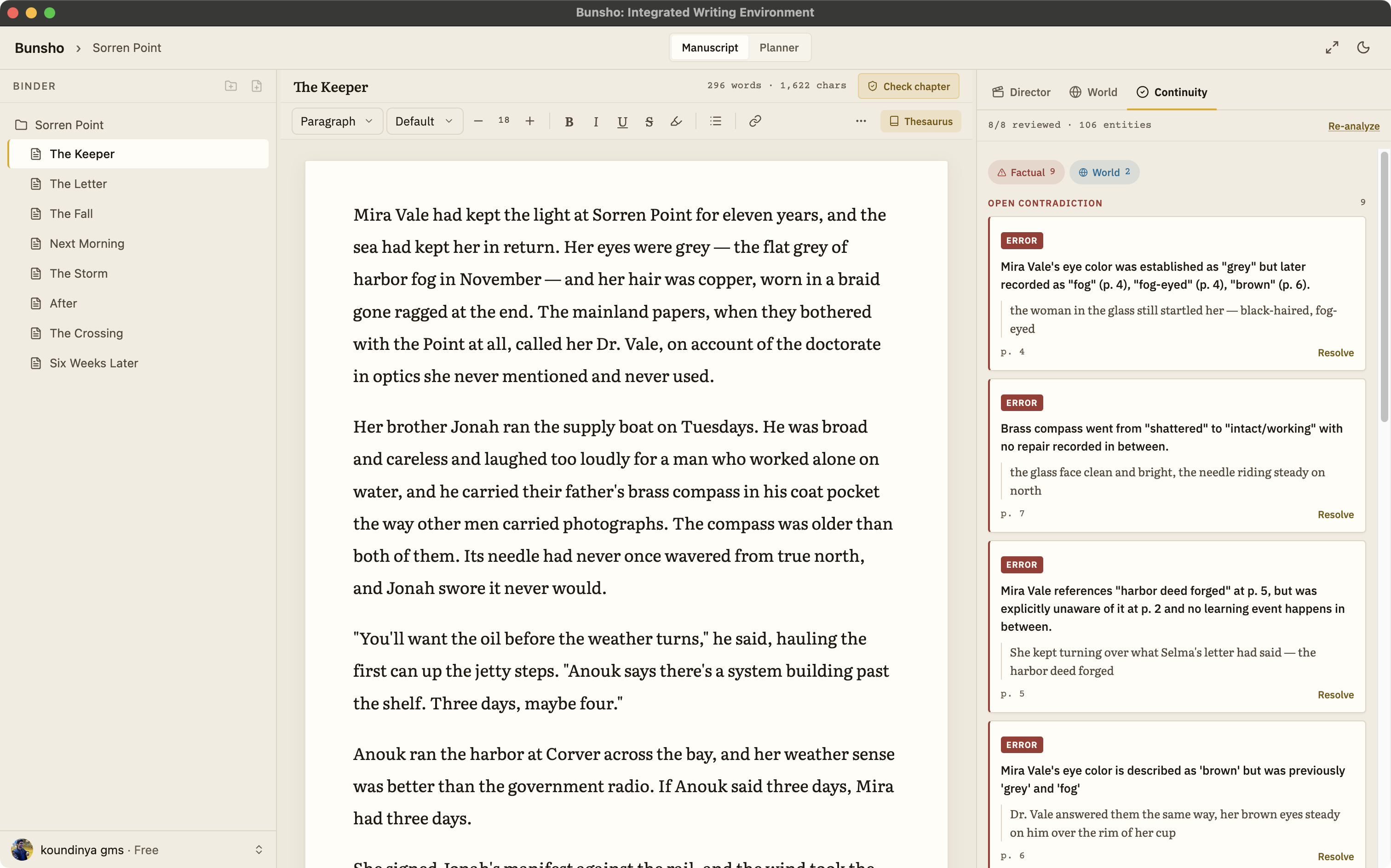
Continuity Scan
Character
Arvind is 27 earlier but listed as 22 in Chapter 12.
World Rule
Teleportation requires a metal artifact — missing in Scene 34.
Timeline
Festival scene is set two weeks before the setup chapter.

Built for novelists, plotters, and discovery writers who care deeply about story logic and continuity — not just pretty sentences.

Story-aware integrated writing environmentContinuity engine built-inPrivate beta — help shape the future

Why writers choose Bunsho

Three lines of a draft, read the way Bunsho reads them

Step through the three things it is doing to your manuscript at every keystroke.

01

It reads while you write

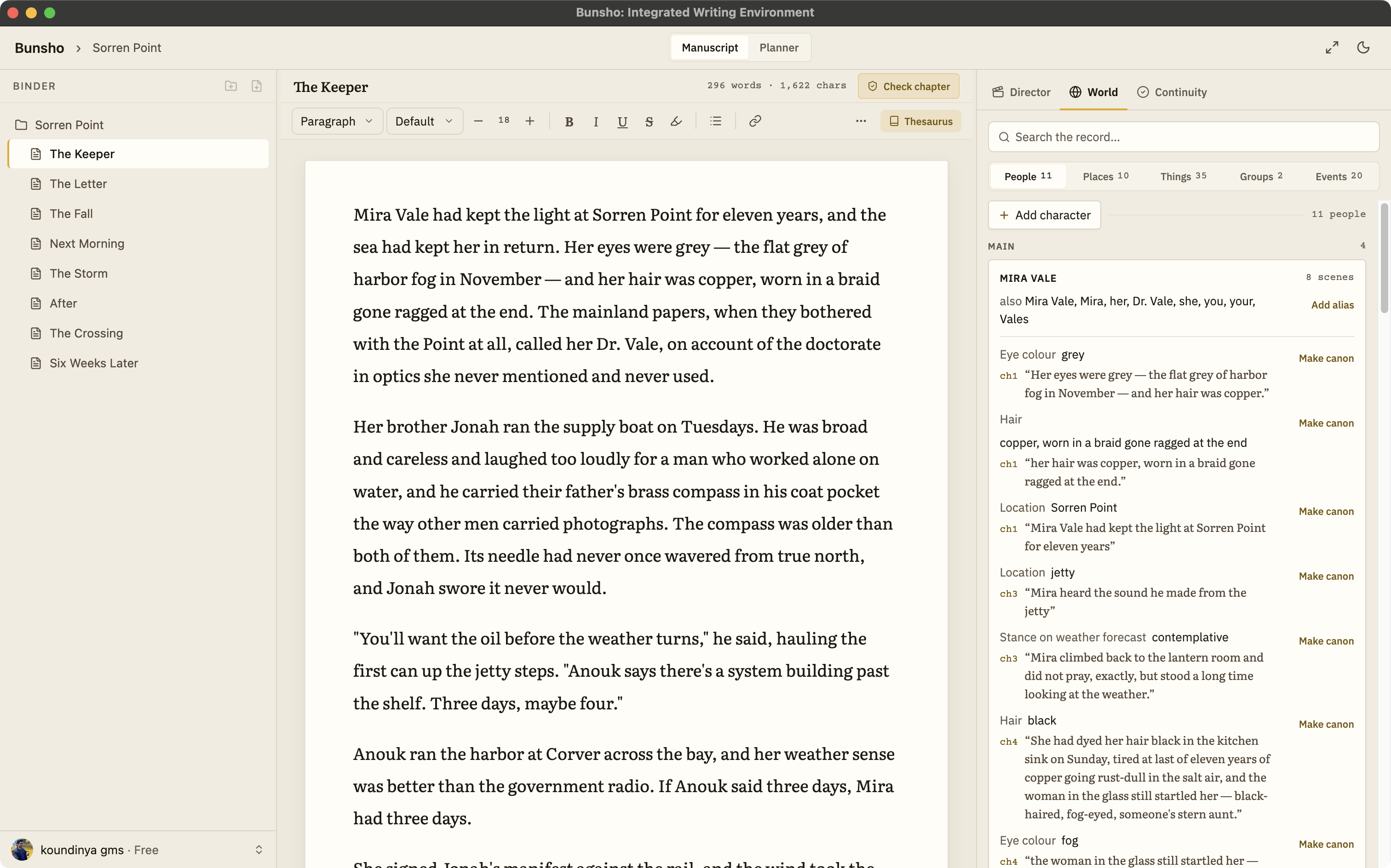
Every character, place, object, and rule you commit to the page is logged into one connected model — built out of your prose, not out of a form you filled in first.

02

It catches the fourth-read mistakes

The age that drifts. The coat left behind two chapters ago. The ride that took three days once and a week later. Flagged with both passages in view.

03

It shows you what a change touches

Fix one fact and Bunsho maps the ripple — every scene, line, and callback that now needs a second look, and none of the ones that don't.

Chapter 9 — draft3 entities linked

Selma set the onionskin letter on the table and pushed it across. Mira read it twice — the second time slower — then folded it into the pocket of her father's coat.

Story model
Mira → Devan (father, deceased since Ch. 2). The coat inherits his last known location: the Corver house.
New object
Onionskin letter — first appearance. Tracked from here forward.

Beyond continuity checking

Direct your characters. Bunsho keeps them honest.

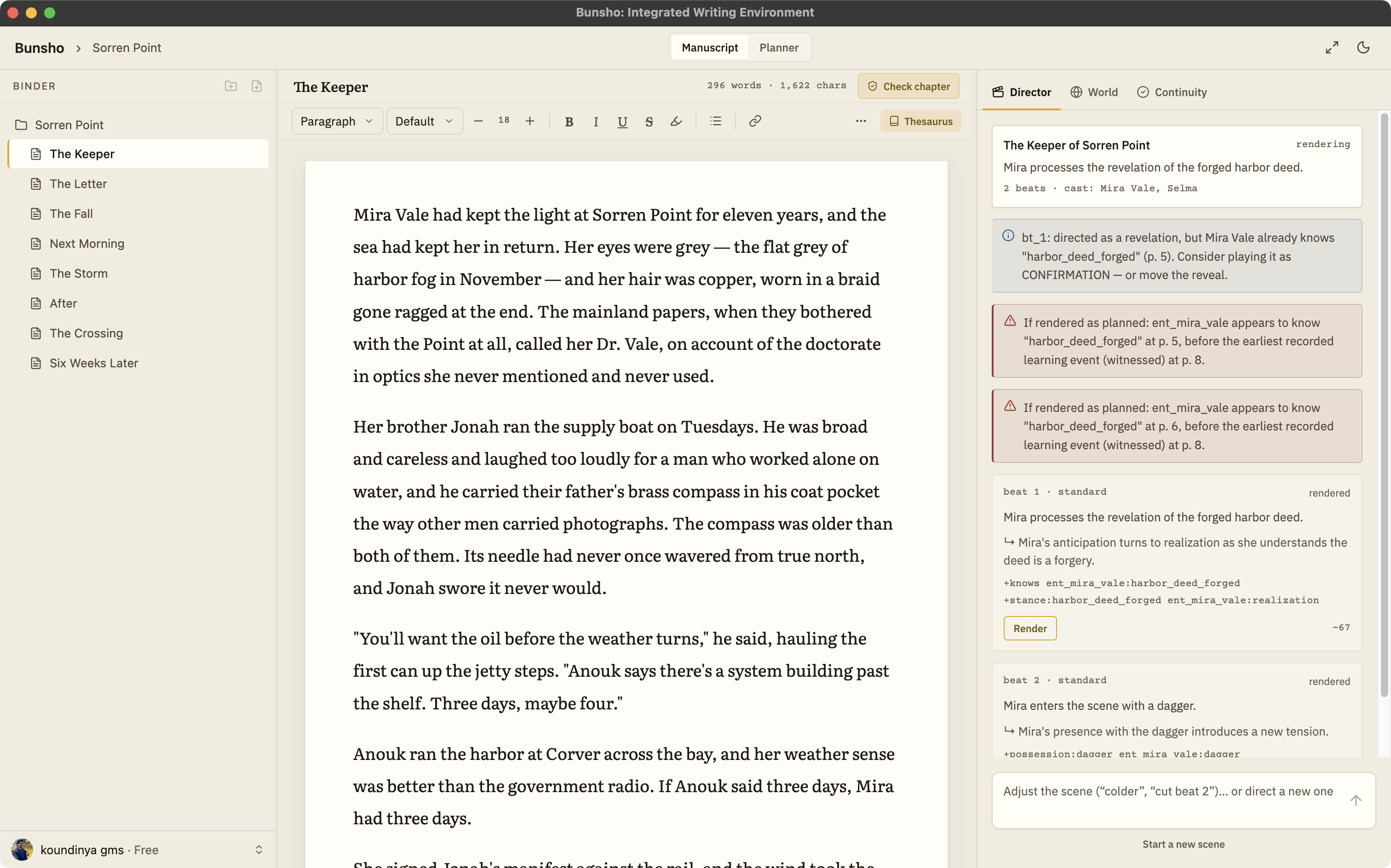
@-tag anyone in your cast, describe what happens next, and Bunsho drafts the scene as a beat sheet — checked against everything your characters already know before a single word of prose is written.

How Director Mode works

Direct the scene

@Selma finally shows @Mira the letter, in the lighthouse kitchen the morning after the storm. Mira doesn’t cry — she gets cold. End with Mira deciding to cross to Corver.

Preflight — before rendering

Directed as a revelation, but Mira already knows the deed was forged (p.5, “The Storm”). Play this beat as confirmation instead?

Beat Sheet3 beats · drafting
1

Selma lays the onionskin letter on the kitchen table and pushes it across.

The secret is physically in the open.

2

Mira reads it once. No tears — stillness, then the cold voice.

Grief converts to resolve.

3

Mira decides: they cross to Corver.

Private knowledge becomes a plan.

Continuity view

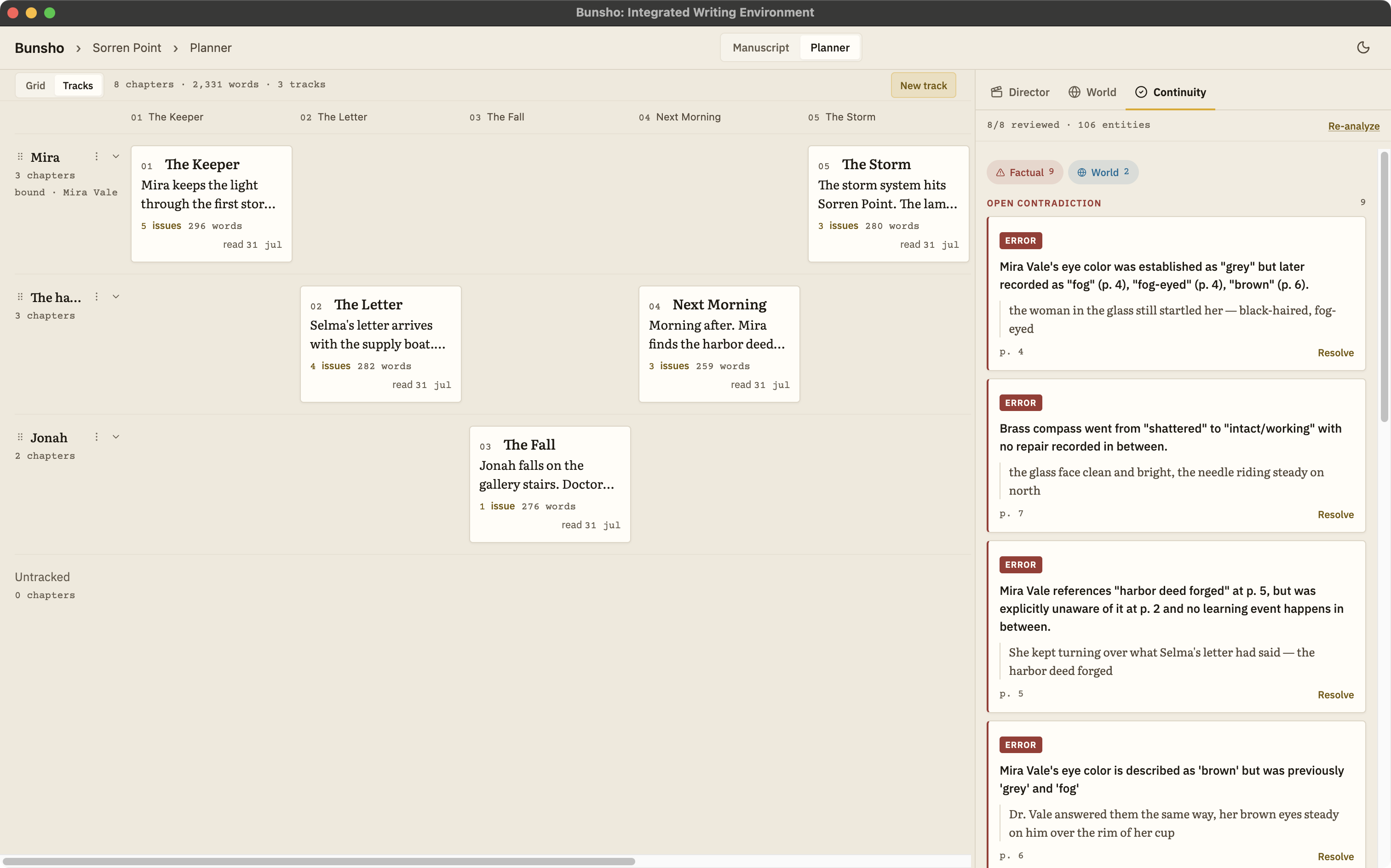
See your story the way Bunsho sees it.

Bunsho quietly models your story as connected elements of characters, events, locations, and rules — then turns that hidden structure into simple continuity insights normal editors miss.

CharactersAuto check

Character Consistency

  • Arvind is 27 earlier but listed as 22 in Chapter 12.
  • Mira stops using her cane even though the injury arc isn’t resolved.
WorldAuto check

World & Rules

  • Teleportation requires a metal artifact — missing in Scene 34.
  • Heist nights only occur during the twin moon cycle (Chapter 15 breaks it).
TimelineAuto check

Timeline Logic

  • Festival scene is set two weeks before the setup chapter.
  • Travel time between Kurnool and the capital contradicts Chapter 3.

Founder story

Why I’m building Bunsho

I’m a novelist and a builder. While drafting my own book, I realized every AI tool helped me rewrite sentences — but none helped me keep the story consistent.

I was constantly flipping back to check character details, timelines, and world rules. I kept spreadsheets, sticky notes, and docs… and still missed things.

Bunsho is my attempt to fix that — an integrated writing environment with a continuity engine built in, so you can focus on the story, not the tracking.

— Koundinya G

Questions from fellow writers

FAQ

What exactly does Bunsho do?

Bunsho is an integrated writing environment (IWE) that builds a connected map of your story — characters, locations, events, and rules — and uses that to catch continuity errors as you write or revise.

Is this an AI that writes my book for me?

No. Bunsho is not a ghostwriter. It’s a continuity and consistency assistant that helps you keep your story logically sound while preserving your own voice.

When is the beta launching?

We’re preparing a private beta soon. Join the waitlist to be among the first invited to try it.

Will there be a desktop app?

Yes. Bunsho is designed as a desktop-first experience. The initial versions may require an internet connection for AI features.

Will the beta be free?

Yes. The early private beta will be free for testers. We’ll share more about pricing closer to a public launch.

Does Bunsho use AI?

Yes. Bunsho uses AI to maintain a persistent understanding of your manuscript and detect continuity issues as it evolves. In Director Mode, it can also draft prose for a scene you direct — but only as a beat sheet you approve first, checked against everything your characters already know before a word is rendered. It never rewrites your existing manuscript without your say-so.

Ready to write with a continuity safety net?

Launching private beta soon. Limited slots for early writers.