Best of
The best continuity checker for novels: every option, honestly
Novelists check continuity five ways: a hand-kept story bible, a spreadsheet, pasting chapters into ChatGPT, Scrivener's metadata, or software built for the job. One test separates them: when chapter twelve contradicts chapter three, does the method read the chapters back and show you both passages? Here is each option held to that bar.
The test that matters
Continuity errors are not knowledge problems; they are attention problems. You knew the wound was on his left hand. You wrote it. The failure happened months later, in a different chapter, on a deadline. So a real continuity checker cannot depend on you noticing, and it cannot answer in vibes. It has to read what you actually wrote, compare it with what the story established, and put both passages in front of you so the verdict takes seconds. Hold every option below to that standard.
The five options
A manual story bible
A document where you record characters, places, and facts as you write. It works exactly as hard as you do, which is the problem: it holds what you remembered to enter, it drifts from the manuscript within a few chapters, and it never reads anything back. Errors are caught only if you think to look something up at the moment you are about to break it.
A spreadsheet
The story bible with sorting. Timelines in one sheet, eye colors in another, a row per chapter. Better recall than prose notes, same blind spot: a spreadsheet cannot compare itself with your chapters. The contradiction lives in the manuscript, and no formula will ever meet it there.
Pasting chapters into ChatGPT
The first method that actually reads your prose, and for one scene or a short piece it can genuinely help. At novel length it degrades: chapters go in batches, earlier ones fade as the conversation grows, nothing persists between sessions, and answers come back without dependable citations. You get an impression of your book, not a record of it.
Scrivener's metadata and character sheets
Keywords, custom fields, and sheets kept next to the manuscript, which beats a separate document. But it is still hand-entered reference material. Scrivener has no continuity checking and no AI; nothing in it compares one chapter against another, so the reading-back half of the job stays yours.
Dedicated continuity checking (Bunsho)
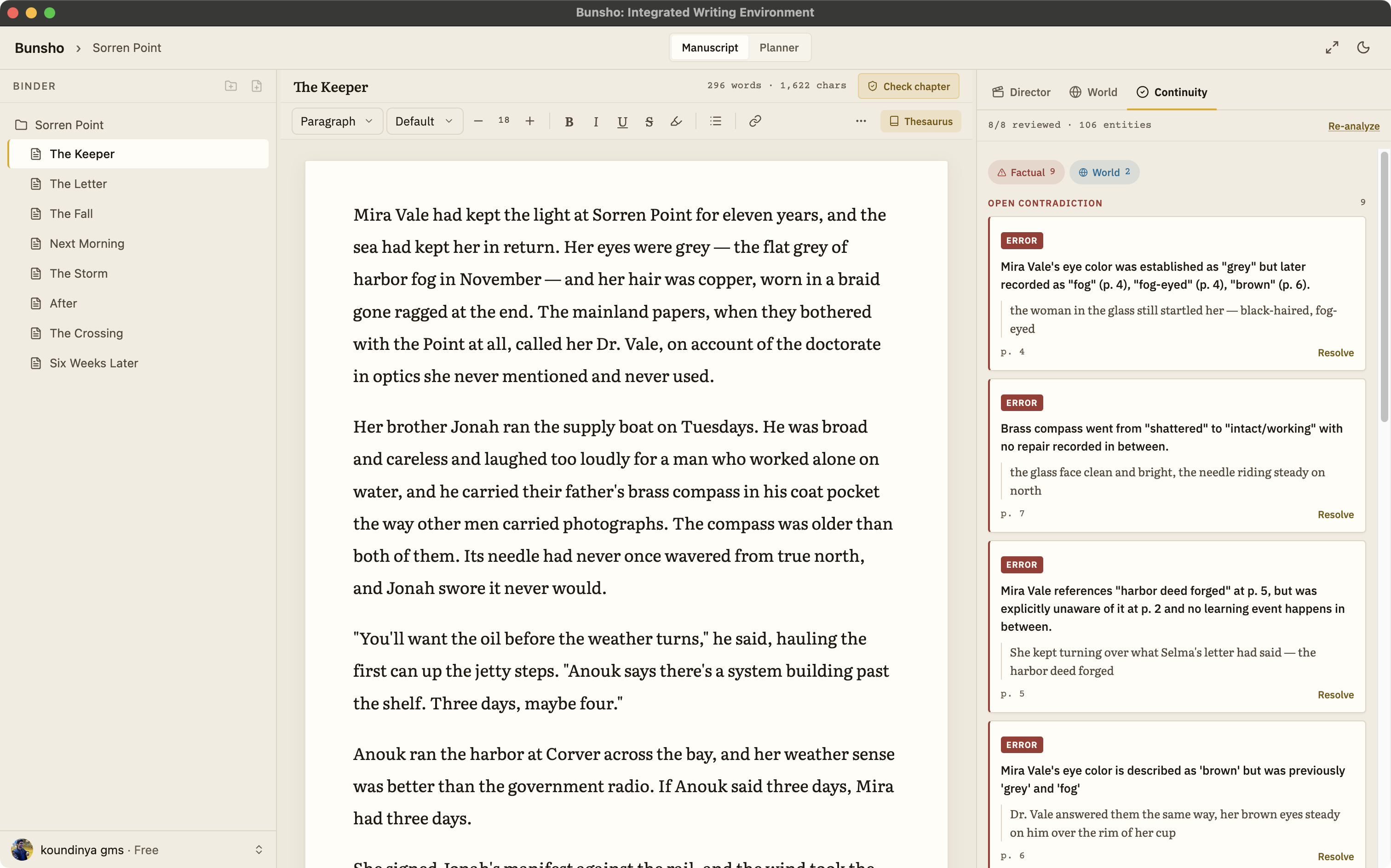
Bunsho is built around the test itself. The World tab fills from your prose with every entry tied to its establishing sentence, and when you ask for a check, on a chapter, on changed pages, or on the whole book, each finding cites both passages: the one that set the fact and the one that broke it. Checking runs when you ask, never while you type.
Scoring the field
Held to the one test, the field splits cleanly. Bibles, spreadsheets, and Scrivener metadata are records: worth keeping, incapable of reading a chapter back. ChatGPT reads but does not remember or cite reliably at book length. As of August 2026, among tools novelists commonly consider, dedicated checking is the only approach that does both, and it is what Bunsho was built to do. The continuity checker page shows how a finding reads, the plot hole checker page covers what it will and will not judge, and Bunsho vs Sudowrite covers the generation-tool question. Bunsho itself is a free download for macOS and Windows, the editor needs no account, and a free sign-in adds 10,000 starter credits for checking.
Common questions
What should a continuity checker actually do?
Read your chapters against what your story has already established and report every contradiction with both passages cited: the sentence that set the fact and the sentence that broke it. Anything less, a note, a hunch, a summary of vibes, still leaves you rereading the manuscript to confirm the problem exists.
Is ChatGPT good enough for checking a novel?
It can catch contradictions inside whatever you paste into one conversation, and for a short story that may be enough. A novel does not fit that shape: you end up pasting chapters in batches, the earlier ones fade from play, and the answers arrive without reliable page references. It is a useful reader; it is not a record of your book.
Do I still need my story bible if I use Bunsho?
You need one more than ever; you just stop typing it. Bunsho's World tab fills itself from your prose, with each entry tied to the sentence that established it, and accepts your own entries as canon. It is the same record your chapters are checked against, so it cannot quietly fall out of date the way a separate document does.
Does Bunsho check while I type?
No, on purpose. Checking is deliberate: Check this chapter, Review changes for everything edited since the last check, or Full review for the whole book, each with the cost shown before it runs. Nothing watches your typing, and writing is never metered.
What does a Bunsho finding look like?
Two quoted passages and a plain statement of the conflict. For example: chapter three establishes that Mira has never seen the letter, and chapter nine has her quoting it. Both passages are shown side by side, with a link to each spot in the manuscript, so you judge the call in seconds instead of rereading six chapters.
Stop rereading. Start checking.
Bunsho is free to download for macOS and Windows. The editor needs no account.