
Import and export
Import a Word manuscript, export to docx, and never get locked in
Bunsho imports .docx, Markdown, plain text, and Fountain, and exports to .docx, Markdown, and Fountain, on every plan. EPUB export is on the roadmap, and in the meantime your chapters are plain files you can open anywhere.
Bringing an existing draft in
Most writers do not start a novel in a new tool. They arrive with sixty thousand words in Word, a Scrivener export, or a folder of Markdown files. Bunsho is built to take that draft as it is: import the file, and the chapters appear in the binder in order, ready to write in and ready to check.
Formats today
Import from Word (.docx)
The format most drafts and most editors live in. Built-in heading styles become chapters in the binder, and every word and paragraph comes through.
Import Markdown and plain text
For writers coming from Typora, Obsidian, iA Writer, or Ulysses exports. Markdown headings become chapters, just like Word headings. A plain .txt file imports as one chapter with its paragraphs preserved.
Import and export Fountain
The open screenplay format. Bring a script in, work on it, and export it back out as .fountain for Final Draft, Highland, or any Fountain-aware tool.
Export to .docx and Markdown
Send a chapter or the whole manuscript to an editor, a first reader, or a typesetter as a Word file, or to a static site or notes app as Markdown. Export is free on every plan.
EPUB: on the roadmap
KDP-ready EPUB export is planned and not shipped. Until then, export .docx and build the ebook in Kindle Create, Vellum, Atticus, or Calibre.
Preparing your manuscript for import
Sometimes an import does not come out the way you expected: one long chapter instead of many, or a title that is not yours. The usual cause is that the file has no headings Bunsho can read, and a few minutes of preparation usually sets it right. If a file still imports badly, that is on us, and we want to know: support@bunsho.io.
Use real heading styles in Word
Bunsho starts a new chapter at every built-in heading style, Heading 1 through Heading 6. Text that only looks like a heading, bold, centered, or set larger, does not start a chapter. Select each chapter title and apply Heading 1 or Heading 2 from the Styles gallery before importing.
Let the first Heading 1 be your title
If the document opens with a Heading 1, Bunsho uses it as the book's title. Otherwise the file name is used, and you can rename the project any time.
In Markdown, one heading line per chapter
A # line becomes the title and each heading after it starts a chapter. Blank lines separate paragraphs. Files saved by Typora, Obsidian, or iA Writer work as they are, with either the .md or .markdown extension.
No headings is fine too
A manuscript with no headings imports as one long chapter rather than failing. Split it into chapters in the binder afterwards, or add headings to the file and import again.
Know what carries over
Every word and paragraph arrives, and your italics and bold come with it. Images, tables, footnotes, and comments do not come through on import today, so keep your original file. Anything you write in Bunsho also exports back to .docx with italics and bold intact.
Coming from Scrivener, Google Docs, or Pages
Export or download the manuscript as .docx with chapter titles set as headings. In Scrivener, compile to .docx with chapter titles formatted as Heading 1 or Heading 2 and the chapters arrive ready-made.
What happens after an import
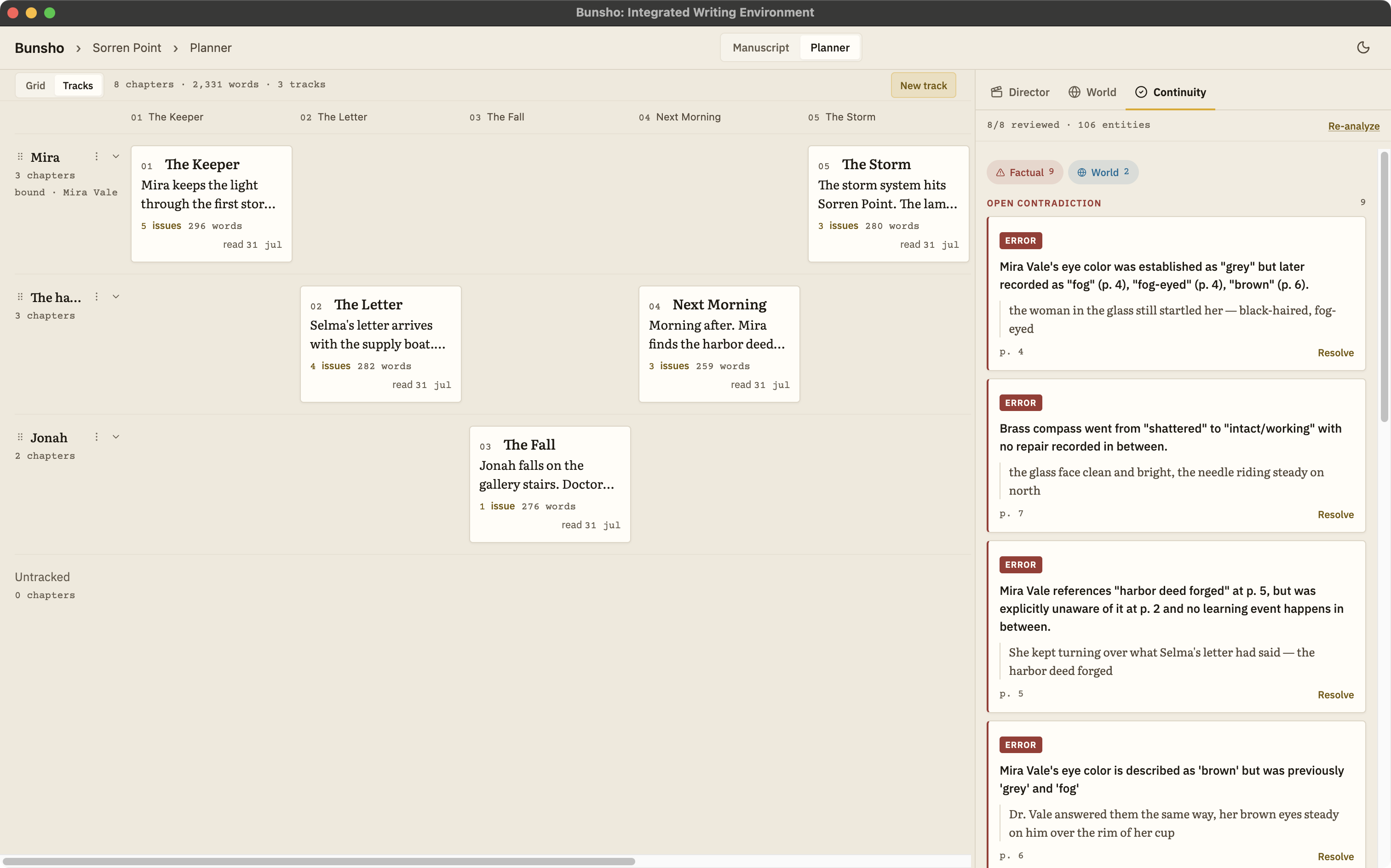
An imported manuscript is just text until Bunsho has read it. So after the first import, Bunsho offers a one-time full read, with the cost shown in credits and a clear option to skip it. Accept, and the World tab fills with your characters, places, and objects, each one tied to the sentence that established it, and the continuity checker has a record to check new chapters against. Decline, and you simply have your book in a quiet editor. Either way, nothing runs after that until you ask for it.
No lock-in, by construction
Export is one way out. The other is that there was never a way in: a Bunsho project is a folder on your disk and your chapters are plain files inside it. You can open them in another editor, keep them in Git, or copy the folder to a new machine. The local-first page explains what stays on your machine, and the editor page covers the writing room itself.
Common questions
Which formats can I import?
Word (.docx), Markdown (.md), plain text (.txt), and Fountain (.fountain) for screenplays. A Word file with chapter headings comes in as chapters in the binder, so a draft written elsewhere is ready to work on without retyping or re-pasting anything.
Which formats can I export?
Word (.docx), Markdown, and Fountain. Export is available on every plan, including Free, and it is never metered. Your manuscript is also stored as plain files in the project folder, so there is always a second way out.
Can I export an EPUB for Kindle or other stores?
Not yet. EPUB export is on the roadmap. Today, export to .docx and build the ebook with the tool you already use, such as Kindle Create, Vellum, Atticus, or Calibre.
Will my formatting survive the round trip?
Your chapter structure, every word, and your italics and bold all survive, in both directions. Styled prose from Word or Markdown keeps its emphasis on the way in, and anything you write in Bunsho exports back to .docx with italics and bold intact. Images, tables, footnotes, and comments do not come through on import, so keep the source document. Bunsho is a manuscript editor, not a page-layout program, so page margins, running headers, and fonts belong in the layout step, after the words are done.
Why did my manuscript import as a single chapter?
Chapter breaks come from headings. In Word that means the built-in Heading styles, not bold or centered text, and in Markdown it means # lines. If the file has none, the whole manuscript imports as one chapter rather than failing, and you can split it in the binder afterwards or add headings and import again.
Does importing a manuscript start a continuity check?
Only if you say so. After the first import, Bunsho offers a one-time full read of the manuscript so the World tab and the continuity checker have something to check against. It shows the cost in credits first and you can decline. After that, checks run only when you ask.
Bring the draft you already have.
Bunsho is free to download for macOS and Windows. Import a manuscript in a minute, no account needed.