
Compare
Bunsho vs Final Draft: the industry formatter and a continuity checker for scripts
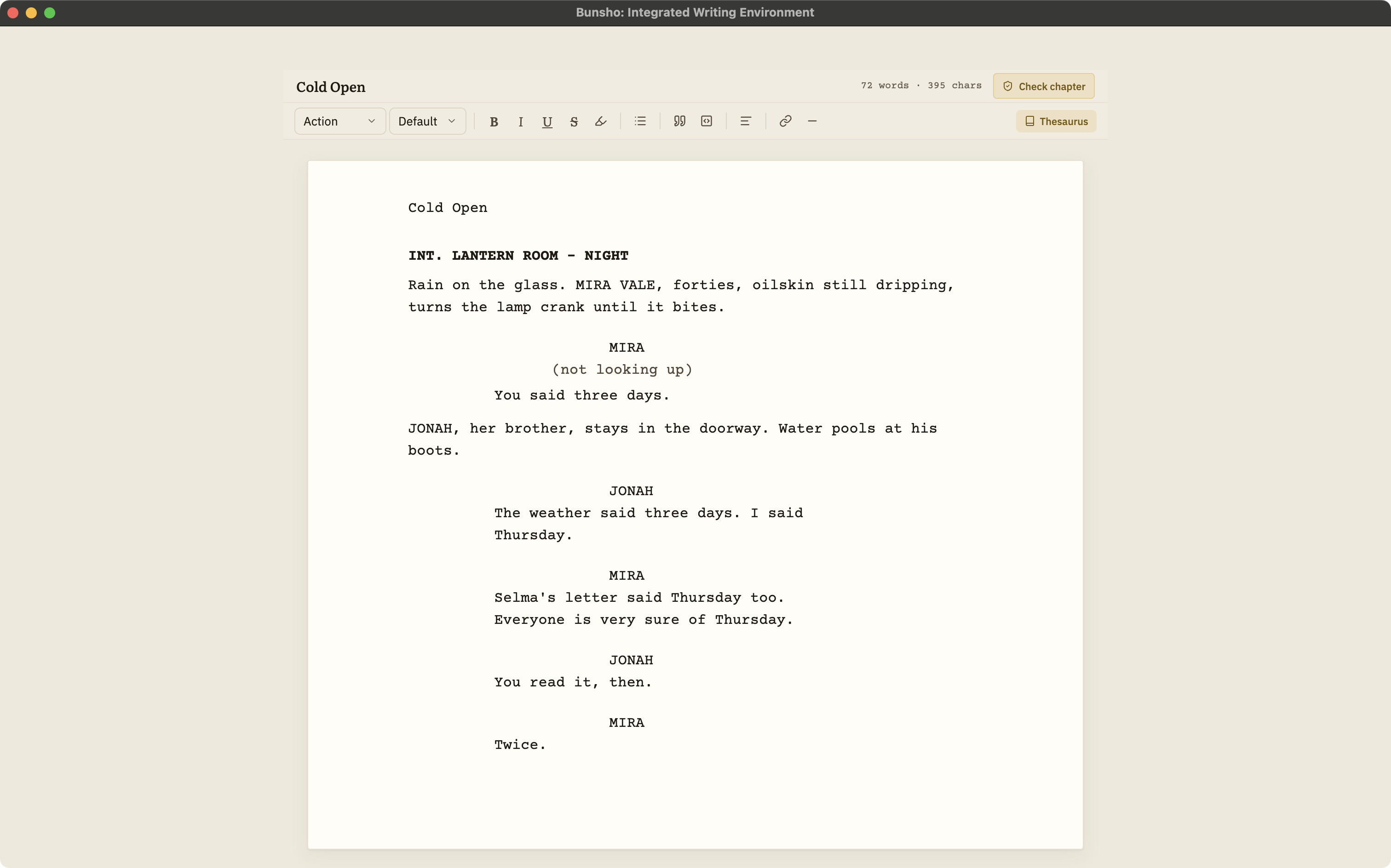
Final Draft and Bunsho are not really rivals. Final Draft is the industry-standard formatter, built to take a script through production with .fdx files, revision pages and reports. Bunsho is a free Fountain editor whose reason to exist is the continuity check: when you ask, it reads your script scene by scene and cites both passages for every contradiction. Most writers who use Bunsho for scripts keep a formatter for delivery. Here is how the two compare, and how they fit together.
The short version
If you need a submission PDF, an .fdx for a production, revision colors or locked pages, Final Draft does that and Bunsho does not. If you need to know whether your script contradicts itself, a costume that changes mid-scene, a character who knows the twist before the scene that tells her, two scenes that cannot both be the same night, Bunsho checks that when you ask and Final Draft does not list it as a feature. They answer different questions, which is why they pair well.
Side by side
| Bunsho | Final Draft 13 | |
|---|---|---|
| Built for | Drafting a script and keeping its story consistent | Formatting a script and taking it through production |
| Platforms | macOS, Windows | macOS, Windows |
| Price | Editor free, no account. Quill $8, Storyteller $15, Saga $29 a month | One-time licence, $249.99 list, often on sale; upgrades from $99.99 |
| Formatting | Six standard elements, element picker, ghost hints, slugline and character autocomplete | Full industry formatting, templates, title pages, dual dialogue |
| File formats | Fountain import and export only | Native .fdx; PDF and other exports; Fountain only as a plain-text import |
| Revisions and production | None | Revision sets with WGA colors, locked pages, omitted scenes, tagging, reports |
| Collaboration | None | Real-time, between Final Draft 13 users |
| Continuity checking | Scene by scene, on request, both passages cited, priced per scene with the cost shown first | Not a listed feature |
| Where files live | Plain files in a folder you choose | Local .fdx files, with optional cloud storage through Final Draft's own service |
Final Draft facts are from finaldraft.com and its help center as of October 2026 and are kept general on purpose; check finaldraft.com for current details.
What Bunsho adds to a Final Draft workflow
A reader for the whole script
Bunsho checks your script against everything it has established: sluglines and scene order, who is in each scene, props and wardrobe, and what each character can know at each point.
Findings you can rule on in seconds
Each finding quotes both passages, the one that set the fact and the one that broke it, so you decide whether it is a slip or a deliberate choice without rereading forty pages.
Checks you start, at a price you see first
Nothing runs on save or in the background. You ask for a check, the confirm dialog shows the per-scene price, and only your click spends anything. Writing, importing and exporting are never metered.
What Final Draft does that Bunsho does not
Be honest with yourself about this list before you plan a workflow. Bunsho does not export PDF, so it cannot produce the file readers, contests and agents receive. It does not read or write .fdx. It has no revision colors, locked pages, scene numbering for production, tagging or reports, no dual dialogue, and no real-time collaboration. If any of those is part of your week, keep Final Draft or another full formatter for that part.
How to use both
Bring the script into Bunsho as Fountain
Final Draft does not write Fountain. Convert the .fdx in an app that reads both, such as Fade In, Highland, WriterDuet or Beat, or draft from the start in Bunsho.
Check the draft before it goes out
Run a check on the scenes you changed or on the whole script, and rule on each finding.
Take it back to Final Draft for delivery
Export .fountain from Bunsho. Final Draft's help center describes importing a Fountain script saved as a .txt file, choosing Script when prompted; or save an .fdx from a Fountain-aware app and open that.
Keep reading
Which alternative fits which reason for leaving: price, platform, collaboration, plain text, or continuity.
Two Fountain-first apps with different jobs.
The pillar guide: formats, collaboration, revisions, price, file ownership, and where Bunsho fits.
Ten apps side by side, each placed by what it is best for.
Screenplay continuity checking in detail: what it reads, what a finding looks like, what it costs.
Common questions
Is Bunsho a replacement for Final Draft?
Not for delivery. Bunsho does not export PDF or .fdx and has no revision or production tools. It is a free script editor with Fountain in and out whose main job is continuity checking, so most writers use it beside Final Draft or another formatter rather than instead of one.
Can Final Draft open a Bunsho script?
Bunsho exports Fountain. Final Draft does not open .fountain files directly, but its help center describes saving the Fountain text as a .txt file and importing it as a Script. You can also open the Fountain file in Fade In, Highland or WriterDuet and save an .fdx for Final Draft.
Does Final Draft have continuity checking?
Not as a listed feature as of October 2026. Final Draft tracks revisions and tags script elements for production, but checking whether the story contradicts itself across scenes is left to the writer. Bunsho does that when you ask, and cites both passages for each finding.
Which is cheaper?
Bunsho's editor is free, and Fountain import and export are free on every plan. Continuity checks need Storyteller ($15 a month) or Saga ($29 a month) and are priced per scene, with the cost shown before each check. Final Draft 13 is a one-time licence listed at $249.99, often discounted.
Do both run on Mac and Windows?
Yes. Final Draft 13 runs on macOS and Windows, and so does Bunsho. Bunsho's editor needs no account and keeps your script as plain files in a folder you choose.
Does Bunsho send my script anywhere?
Your manuscript lives on your machine, not on our servers. Pages are sent for analysis only when you run a check, and they're never stored or used for training.
Format in Final Draft. Check the story in Bunsho.
Bunsho is free to download for macOS and Windows with no account. Screenplay checks are live on Storyteller and Saga, priced per scene.