
For fantasy and sci-fi writers
A worldbuilding consistency tool that holds your rules
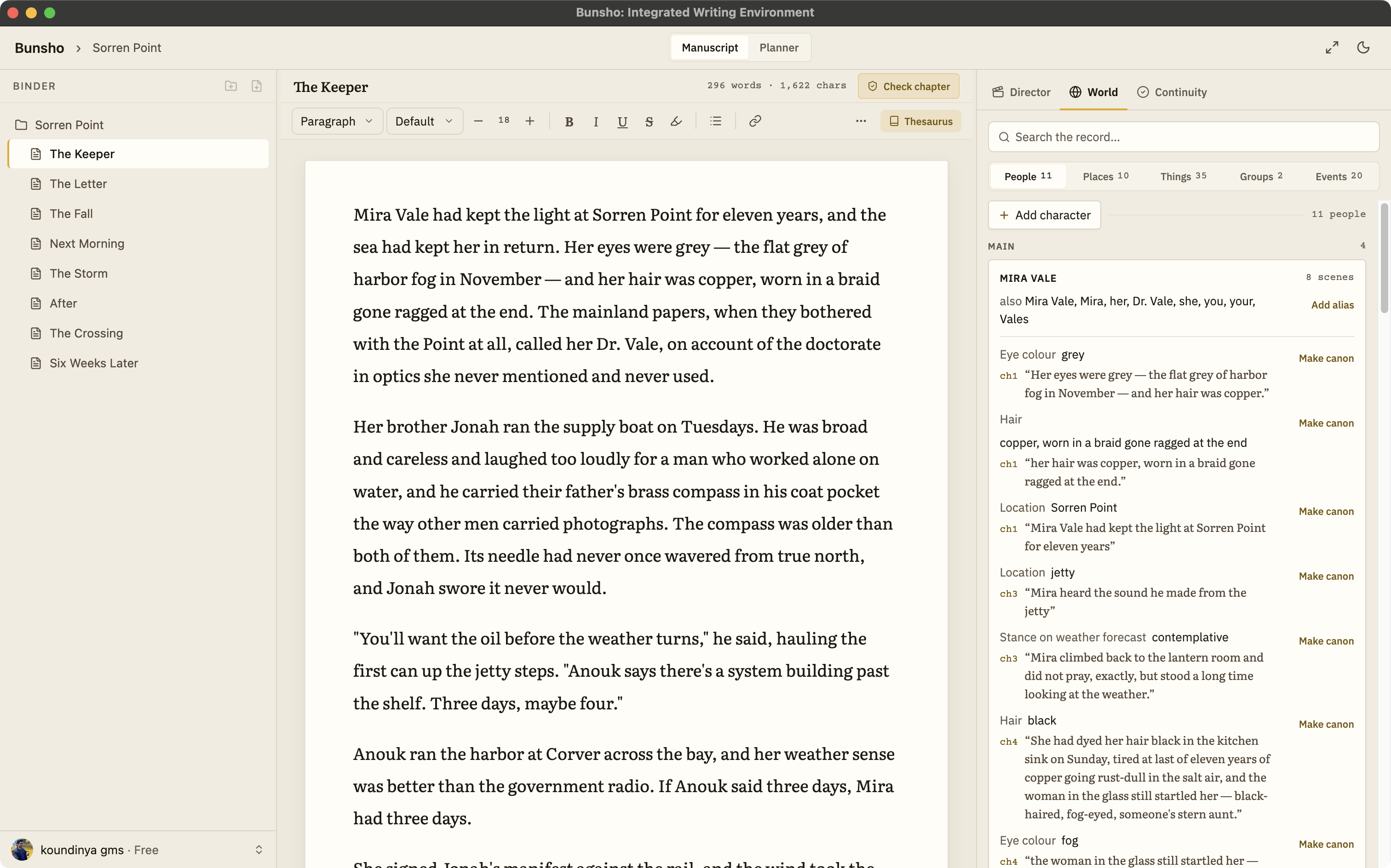
Fantasy and science fiction run on rules the real world never wrote down, which means nobody but you can catch the chapter that breaks one. Bunsho keeps your magic system, invented geography, and world rules in the World tab beside the page, and flags the scene that violates them with both passages cited.
Invented worlds fail in invented ways
A contemporary novelist can lean on the real world: Paris stays where it is, and gravity needs no continuity notes. A fantasy or science fiction writer is the sole authority on how everything works, and the reader is taking notes. If the wards fall when the caster sleeps, chapter thirty cannot have them holding through the night. If the crossing to the archipelago takes a week by sail, a message cannot arrive in two days without an explanation. These are not style problems. They are broken promises, and genre readers treat them that way.
The stakes rise with the ambition of the world. More rules, more places, more names, more history: more ways for one chapter to quietly disagree with another.
What Bunsho holds steady
The rules of your world
Write each rule into the World tab once, in plain language. Hand entries are canon, so a check measures every chapter against the rule and flags the scene where the cost is not paid or the limit is not honoured.
Invented geography
Every place your story names gets an entry: who has been there, what happened, what the prose has said about distances and routes. When a journey shortens between drafts, the check cites the two passages that disagree.
A large cast with long memories
Characters carry physical details, traits, possessions, and what they know. A soldier who has never seen the capital cannot describe its gates; a character who was not in the room cannot repeat what was said there. Findings show where each fact came from.
Objects with histories
The sword, the beacon, the seed vault. The World tab records what the manuscript has said about an object and where, so its provenance survives forty chapters of handling.
Checks on your schedule
Nothing runs while you draft. Check a chapter when it is done, review changed pages before a revision pass, or run a full review. The cost is shown before anything runs, and writing is never metered.
Judge, not co-author
Bunsho does not generate worldbuilding and has no opinion on what your world should contain. Its one job is to hold your book to the promises the book itself makes. That is also what keeps false alarms down: a finding must cite two passages of yours that disagree, or a passage that disagrees with an entry you wrote, so you are never arguing with a vague feeling. See how a finding reads on the continuity page.
If you keep a separate worldbuilding document today, the story bible software page covers how the World tab replaces it without the upkeep, and the World tab page goes deeper on what gets tracked. Writing a trilogy or longer? The series writers page explains what works across books today and what is on the roadmap.
Common questions
Can Bunsho hold the rules of my magic system?
Yes. Pin a rule to the World tab in your own words: healing magic costs the healer a memory, the gates only open at the equinox, faster-than-light travel needs a beacon at both ends. Hand entries are canon, and a check measures your chapters against them and flags the scene where a rule quietly bends.
Does it understand invented names and places?
The World tab is built from your manuscript, so it tracks the people and places your prose establishes, whatever they are called. Invented cities, ships, houses, and orders get entries like any character does, with each detail tied to the sentence that set it.
Will it complain that magic is impossible?
No. Bunsho has no opinion about what should be true in your world. It cares whether your book agrees with itself. If your dragons speak in chapter two, the only problem worth flagging is a chapter where they cannot.
How is this different from keeping a wiki or worldbuilding notes?
Notes are one-way: you write them, and nothing checks the manuscript against them. Bunsho's World tab is two-way. It fills itself from your chapters, you correct or extend it by hand, and the continuity checker holds your prose to what it says, citing both passages whenever they disagree.
Do I need an account to try it?
Not for the editor. Bunsho is free to download for macOS and Windows, and the editor, World, and Planner need no account. Reading your manuscript into the World tab and running checks are AI features behind a free sign-in, which comes with 10,000 starter credits.
Your world, kept to its own rules.
Bunsho is free to download for macOS and Windows. No account needed for the editor, World, or Planner.