
For mystery and thriller writers
Keep your clues, alibis, and timeline straight
Mysteries and thrillers are built on fair-play clues, alibis, and who knew what when. Bunsho keeps those facts on record and checks your chapters against them when you ask, citing both passages so you can decide: slip or deliberate?
The reader who rereads to check the clues
Plenty of readers finish a mystery and go back to see whether it was fair. They check the alibi against the timeline. They look for the moment the detective learned the thing she could not have known yet. If one fact on page ninety quietly disagrees with page two hundred, that is the reader who finds it, and in this genre it can undo the solution rather than merely dent it.
You cannot easily see it yourself. Over a year of drafts and rewrites the order of events changes, a suspect gets moved to a different evening, a clue is planted earlier or later, and the facts around it do not always move with it. The usual defence is a timeline spreadsheet and a clue chart, kept up to date by hand around a book that keeps changing.
What Bunsho keeps straight
Who knows what, and since when
The heart of every whodunit. Bunsho tracks what each character knows and when they learned it, and flags a scene where someone acts on information she has not been given yet, with both passages in view.
Alibis and where everyone was
Who was in which room, which town, which side of the bridge. When a character turns up somewhere that sits badly with where an earlier chapter put her, the check shows both passages so you can tell a slip from a lie she is telling.
The timeline of the crime and the investigation
Time of death, the hours of the night, the days of the case. A check flags a scene whose timing sits uneasily with what the book has already established, so the order of events holds up when a reader lays it out on paper.
Objects and their condition
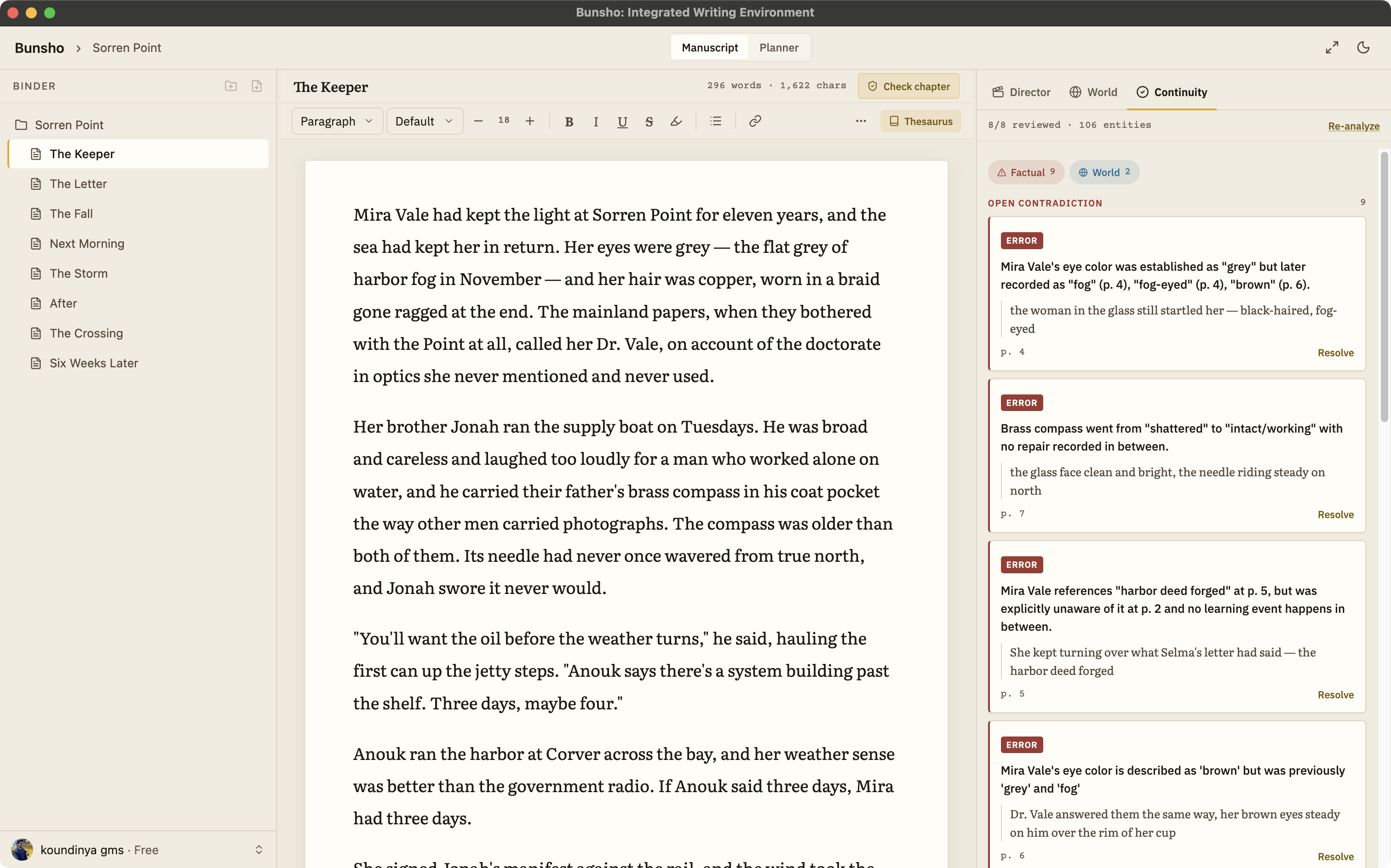
The weapon, the key, the phone with the cracked screen. Bunsho keeps what state each object is in and flags the chapter where it is whole after it was broken, or in a pocket after it was left on the table.
Character details that must not drift
A scar, a limp, a left-handed suspect, a dead man's age. These details carry clues in this genre, so the World tab keeps each one tied to the sentence that set it, and a check flags the chapter that quietly disagrees.
Your own canon, written in by hand
Know a fact the prose has not stated yet, such as who the killer is, or when the murder really happened? Add it to the World tab. Anything you write there by hand is canon, and the checker holds your chapters to it.
Slip or deliberate? You decide.
A mystery is full of things that look like contradictions on purpose: the witness who lies, the narrator who leaves something out, the clue that means something else on a second reading. Bunsho does not tell you that you made an error. It raises a question, shows the two passages side by side, and leaves the call to you. Decide it is deliberate and move on, or fix the slip before a reader finds it.
It will not solve your plot, judge your twist, or write a single line for you, and it does not check real-world facts such as police procedure or forensics. It checks that your book agrees with itself. For what a finding looks like when a check runs, see the continuity checker; for the broader question of holes in the logic, see the plot hole checker; and for the record of characters, places, and objects that the checks lean on, see the World tab.
Checking when you ask, not while you draft
Nothing runs while you write, and writing is never metered. Check a chapter when you finish it, review just the changes after a rewrite moves the evening a suspect was seen, or run a full review before the manuscript goes to an editor or agent. The cost is shown before anything runs. For a recurring detective across books, see the series roadmap.
Common questions
Why is continuity so unforgiving in mysteries and thrillers?
Because the reader is checking. In most genres a drifting detail is a blemish. In a mystery it can unravel the solution: if the alibi times do not add up, or a character acts on something she was never told, the reader who rereads to test the clues will find it. Fair play means the facts on the page have to hold still.
Can it help me keep track of clues and red herrings?
It keeps the facts those clues are built from on record: who was where, what each character knows and when they learned it, what condition an object is in. Bunsho does not decide which clues matter or whether your red herring is fair. That design is yours. What it does is check that the details underneath hold steady from chapter to chapter.
Does it check my timeline?
Yes. Bunsho reads when things happen in your chapters and flags a scene that sits uneasily with the order or timing established elsewhere: a night that is two hours long in one chapter and five in another, a drive that takes twenty minutes once and an hour later. Each finding shows both passages. Sometimes the slip is deliberate, such as an unreliable narrator or a lie in an alibi, and you decide that.
What about a deliberate lie or an unreliable narrator?
That is why every finding is a question rather than a verdict. A suspect who lies about where she was will look like a contradiction, and that is the point of the scene. Bunsho shows you the two passages and you decide: slip or deliberate. You stay the author of every call.
Will it spot a plot hole in my solution?
It finds contradictions against what your own book has established, which covers many of the holes a solution can hide: a detective who knows too much too early, a killer in two places, an object that is broken and then whole. It does not solve the plot, judge whether your twist is satisfying, or check real-world facts such as police procedure, forensics, or history.
Does it work across a series with a recurring detective?
Honestly: within one book today, across books on the roadmap. Each book is its own project. Anything you add to the World tab by hand is canon, so you can record what earlier books settled about your detective and the checker holds the new book to it. One shared canon across a series is the feature we are building next.
Will checking meter my writing or slow my draft?
No. Writing is never metered and needs no account for the editor. Checks run only when you ask, with the cost shown first: check a chapter when you finish it, review just the pages that changed after a rewrite, or run a full review before the manuscript goes out.
Can I bring in a draft I have already written?
Yes. Import .docx, Markdown, or .txt, and Bunsho reads it and builds the World tab from the prose, so you can see who knows what and where everyone was without compiling it by hand. Export goes back out as .docx or Markdown.
Your readers will reread. Your book should hold up.
Bunsho is free to download for macOS and Windows. No account needed for the editor; World and Planner come with a free sign-in.