
Features: World
A character tracker for novelists that reads your manuscript
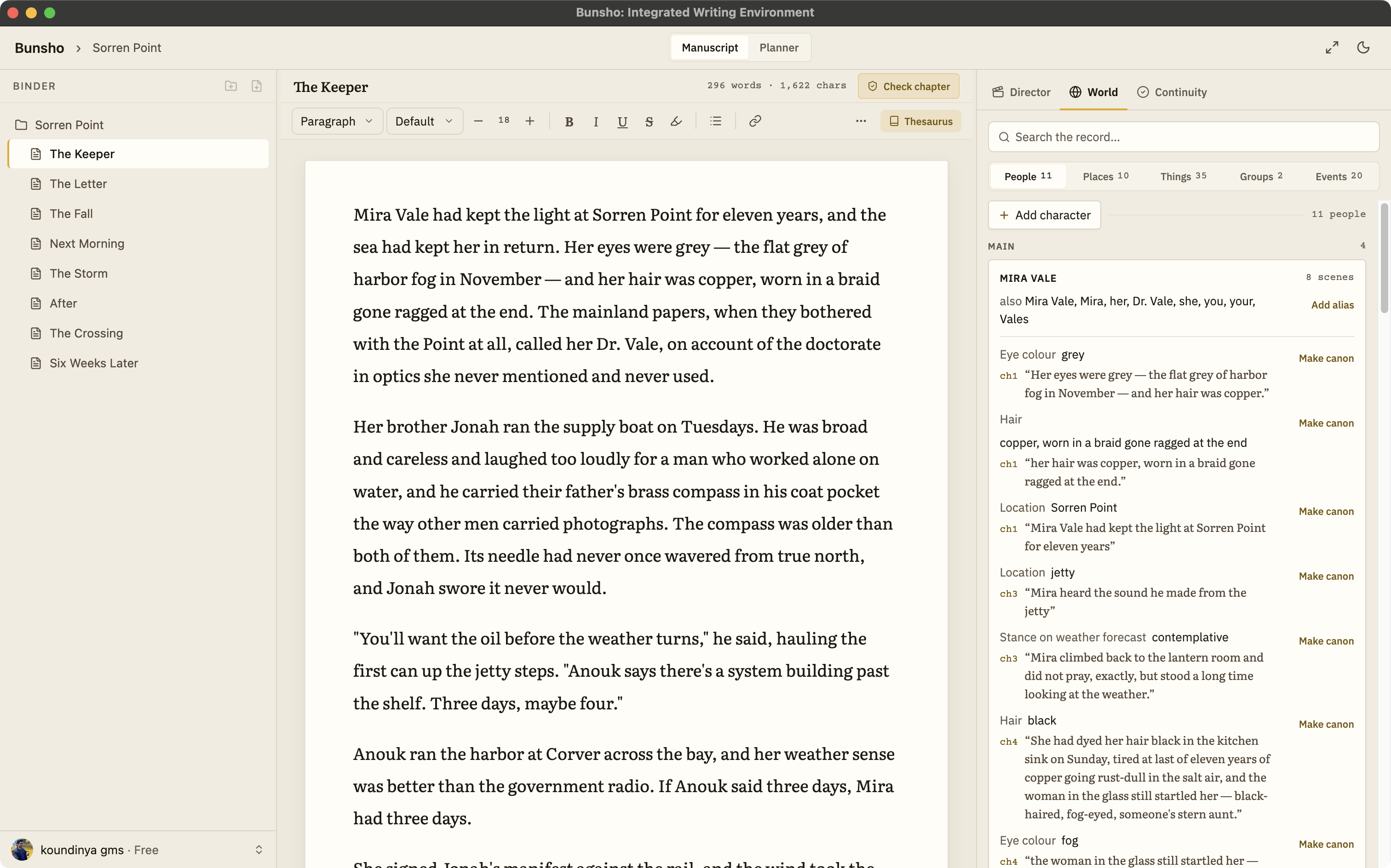
The World tab keeps track of every character, place, object, and relationship in your novel, and it fills itself from your chapters rather than waiting for you to type it all in. Every found detail is tied to the sentence that established it, and anything you add by hand becomes canon.
The facts that drift
By the middle of a draft a novel carries hundreds of small commitments. Arvind is twenty-seven. The inn is two days' ride from the capital. The compass was Jonah's father's. Mira does not yet know about the letter. None of these are hard to remember on the day you write them. All of them are easy to contradict forty chapters later, when you are concentrating on the scene and not on the ledger.
Character trackers exist to hold that ledger. Most of them ask you to maintain it. Bunsho's World tab maintains it from the manuscript and lets you correct it where the manuscript is wrong.
What the World tab tracks
Characters
Physical details, traits, age, what they carry, where they have been, who they are tied to, and what they know. Each detail points at the sentence that established it, so an entry is a set of receipts rather than a summary.
Places
Every location the story has named, with who has been there and what happened. Useful when a character needs to be somewhere and you cannot remember whether she has ever been.
Objects
The letter, the compass, the broken watch. The World tab records what the manuscript has said about an object and where, so you can check its history before you hand it to someone new.
Relationships
How two characters stand with each other as the book has established it: sisters, rivals, a debt owed, a secret kept from one of them. The ties your plot depends on, in one place.
Hand entries
Add a character before she has a scene, pin a rule of your world, or correct a found detail. Hand entries are canon. The continuity checker treats them as the truth and checks your chapters against them.
What a found entry looks like
Open Mira and the entry reads the way a careful reader's notes would: grey eyes, a scar across the left palm, younger sister of Selma, last seen in the harbour office. Beside each line sits the chapter and the sentence that said so. If one of those lines is wrong, you change it, and the entry is marked as yours from then on.
That distinction between found and hand-entered is the whole point. A found entry tells you what your manuscript currently says. A hand entry tells Bunsho what your manuscript should say. The continuity checker reads both and flags every chapter that disagrees, with both passages in view.
Where it fits
The World tab sits in the right-hand panel beside your page, with Chat and Continuity as its neighbours, so looking something up does not mean leaving the manuscript. It is the same memory that Director Mode answers to when it drafts a scene, which is why a drafted character cannot say something she has not yet learned. For the wider case, using the World tab as a story bible that keeps itself current, see story bible software.
Everything in the World tab lives on your machine with the rest of your project. Only the pages you choose to check are sent for analysis, and they are never used to train models.
Common questions
How is this different from a character sheet template?
A template is a form you fill in and then forget to update. The World tab reads your chapters and fills itself, and each found detail points at the sentence it came from. When the draft changes, a fresh read updates the entry, and when you change an entry by hand, the continuity checker holds your chapters to it.
Does it track more than characters?
Yes. Places, objects, and relationships have entries of their own, alongside the rules of your world. A place records who has been there and what happened. An object records what the manuscript has said about it. A relationship records how two characters stand with each other as the book has established it.
What if Bunsho gets a detail wrong?
Edit it. Hand entries are canon, so your correction wins over the found entry from then on, and a later check measures the manuscript against what you wrote. Nothing is silently overwritten.
Can I add a character who has not appeared yet?
Yes. Add her by hand with whatever you know, and the entry is waiting when she walks into chapter twelve. If the chapter gives her a different eye colour than the one you recorded, the continuity checker will say so with both passages in view.
Is the World tab free?
The editor, World, and Planner are free to download for macOS and Windows, with no account. Reading entries out of your manuscript and checking chapters against them are AI features and need a free sign-in, which includes 10,000 starter credits.
Keep every character straight.
Bunsho is free to download for macOS and Windows. No account needed for the editor, World, or Planner.