
Compare
Bunsho vs ChatGPT: checking a novel's continuity with a chat window
Every writer who has tried it knows the routine: paste chapters into ChatGPT, ask if anything contradicts, get a confident answer, and then re-paste it all next week because the chat remembers none of it. Bunsho is a manuscript editor that remembers what your story has established and checks your chapters against it, with both passages cited on every finding.
The short version
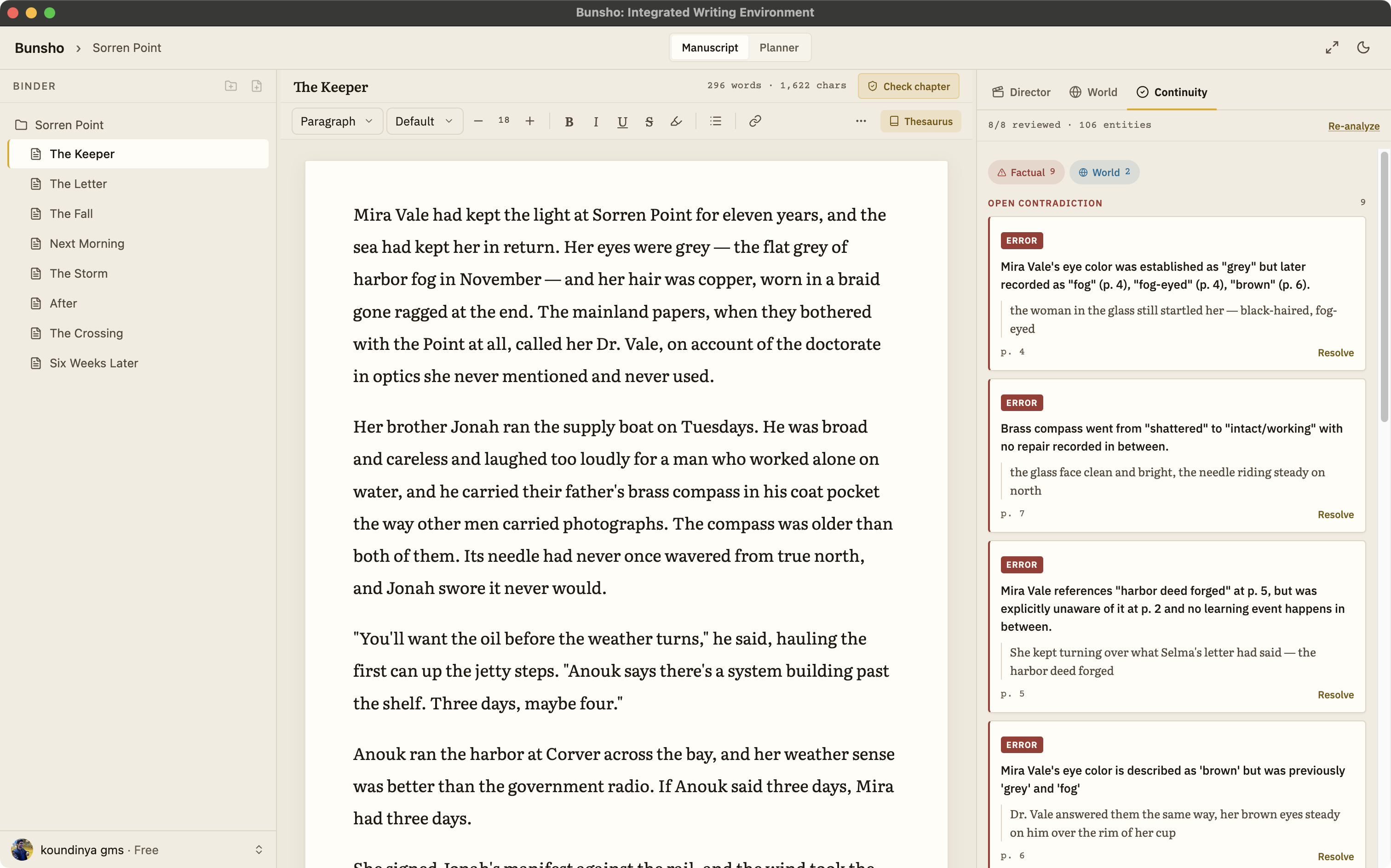
ChatGPT reads whatever you pasted most recently. A full manuscript does not fit, earlier chapters fall away as the conversation grows, and the next session starts from nothing. When it answers, it answers in confident prose with no citations into your files, so a missed contradiction and an invented one look exactly the same. Bunsho starts from the opposite end: it is an editor your manuscript lives in, it remembers what the story has established, and when you ask for a check, every finding arrives with both passages cited, the sentence that set the fact and the sentence that broke it, so you can rule on it in seconds.
Side by side
| Bunsho | ChatGPT | |
|---|---|---|
| Knows your manuscript | Remembers what your story has established across the whole book, tied to the sentences that established it | Reads what you pasted into the conversation; earlier chapters fall out of reach as the chat grows |
| Between sessions | Nothing to re-teach. Your project opens where you left it, with everything the story has established intact | A new chat starts from nothing; you paste the chapters again |
| Findings | Each finding cites both passages, the one that set the fact and the one that broke it, linked into the manuscript | Prose answers without citations into your files; you verify each claim yourself |
| False alarms | Built to stay quiet unless the manuscript disagrees with itself; a finding you dismiss stays dismissed | Confident either way; it can miss real contradictions and report ones that are not there |
| Where your manuscript lives | Plain files on your machine. Only the pages being checked are sent, never used for training | Pasted or uploaded into a chat service's conversation |
| Built for | Manuscripts: a binder, a page, a Planner, a World tab, and deliberate checks with costs shown first | General conversation; a novel is one more wall of pasted text |
Why the chat routine breaks down
The window forgets your book
A novel is longer than a conversation. Chapters you pasted an hour ago quietly stop informing the answers, and a check of chapter twenty against chapter two only works if both happen to still be in view. Bunsho keeps everything the story has established, book-wide, without you managing what fits.
You start over every session
Close the chat and the work is gone; tomorrow you paste again. In Bunsho the manuscript is the project. It opens where you left it, and Review changes checks only the pages that changed since their last check, cost shown first.
Answers come without receipts
A chat gives you prose about your prose, and you become the fact-checker of your own fact-checker. Bunsho never reports a contradiction without citing both passages, linked to their places in the manuscript.
Your book becomes chat history
Pasting a manuscript into a chat service puts it in that conversation, under that service's terms. In Bunsho your chapters stay plain files on your machine; only the pages being checked are sent, and they are never used to train models.
What Bunsho does not try to do
Bunsho is not a general assistant. It will not plan your marketing, answer trivia, or chat about anything beyond your book, and it does not continue your prose unprompted. It is an editor with a memory and a deliberate checker: how a finding reads is on the continuity checker page, the World tab holds what the manuscript has established, and the local-first page explains what stays on your machine.
Common questions
Can I bring the manuscript I have been pasting into ChatGPT?
Yes, bring the manuscript itself. Bunsho imports .docx, Markdown, plain text, and Fountain, and on first import offers a full review of the whole book with the cost shown before it runs. From then on your chapters are checked against what the manuscript has established, not against whatever fit in a chat.
Why not just paste my chapters into ChatGPT and ask?
Because a chat reads only what you pasted, and long manuscripts do not fit. Earlier chapters fall away, the next session starts from nothing, and the answer is a plausible paragraph you then have to verify yourself against your own book. A wrong "looks consistent" costs you a reader's one-star review; a vague "there may be inconsistencies" costs you an afternoon.
What does a Bunsho finding look like?
Every finding cites both passages: the sentence that established the fact and the sentence that contradicts it, each linked to its place in the manuscript. You read the two lines and rule on it in seconds. No finding ever arrives without its receipts.
Is my manuscript safer in Bunsho than in a chat?
Your chapters are plain files on your machine, and the editor needs no account. When you ask for a check, only the pages being checked are sent for analysis, and they are never used to train models.
Does Bunsho cost more than a chat subscription?
The editor is free with no account. AI features unlock with a free sign-in and 10,000 starter credits; Storyteller is $15 a month with the continuity checker and a monthly allowance, and Saga is $29 with a higher limit. Checks show their cost before they run, and writing is never metered.
Stop pasting chapters. Start checking them.
Bunsho is free to download for macOS and Windows. The editor needs no account.