The World tab
Story bible software that writes itself
Bunsho reads your manuscript and fills in the story bible for you: characters, places, objects, relationships, and world rules, each tied to the sentence that established it. It works both ways, so what you add by hand becomes canon and your chapters are checked against it.
Why story bibles fall behind
Every novelist has started one. A spreadsheet of characters, a document of place names, a page of rules for how magic or money or the law works in the book. Then the draft takes over. The bible says one thing, chapter nineteen says another, and neither gets corrected because keeping the two in step is a second job nobody signed up for.
The problem is not discipline. It is that a bible kept in a separate document has no way of knowing what the manuscript says. Bunsho keeps the bible inside the editor and lets the manuscript do the filing.
How the World tab works
It fills itself from your chapters
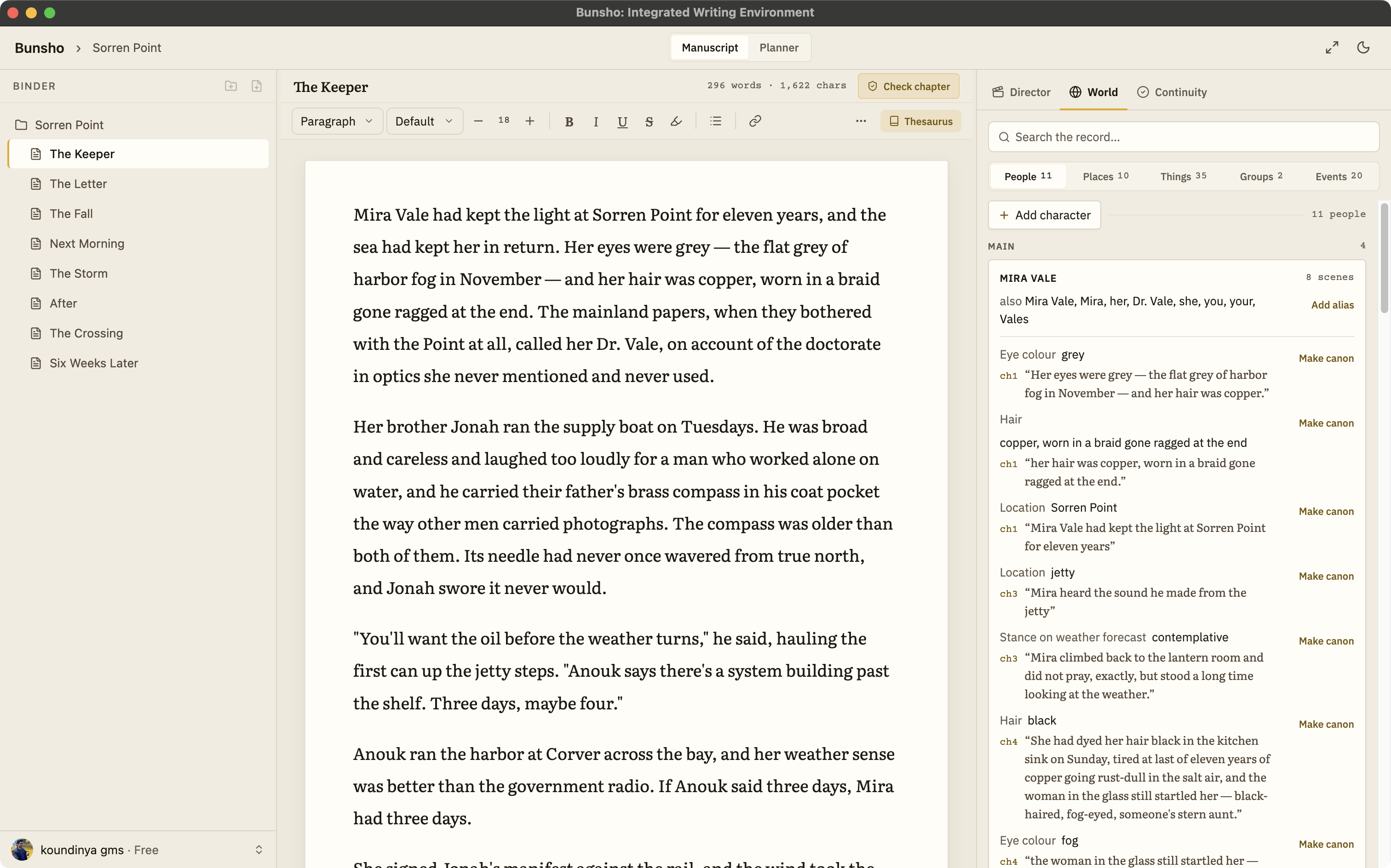
When Bunsho reads a chapter, the characters, places, objects, and relationships it finds appear as entries in the World tab. You do not retype a fact you have already written into the prose.
Every found entry shows its source
A found entry is tied to the sentence that established it. Open a character and you can see where the manuscript first gave her an age, a scar, a sister, or a secret.
Hand entries are canon
Add a character before she has a scene, correct a detail, or pin a rule of your world. The continuity checker treats what you wrote there as the truth and measures your chapters against it.
It is two-way
Most story bible tools are a place to take notes. In Bunsho the bible is also what the continuity checker reads, so a bible entry is not a reminder to yourself but a fact the software holds your manuscript to.
It never leaves your machine until you ask
Manuscripts and the World tab stay on your computer. Only the pages you choose to check are sent for analysis, and they are never used to train models.
What a bible entry looks like
Open a character and you get what a careful reader would have noted: traits and physical details, where she has been, what she owns, who she is tied to, and what she knows. Open a place and you get who has been there and what happened. Open an object and you see what the manuscript has said about it and where. Each line that came from the manuscript points back at its sentence; each line you wrote yourself is marked as yours.
That matters at revision time. Change a character's age in the World tab and then run a full review, and every chapter that disagrees with the new age is flagged with both passages in view. The bible stops being a document you consult and becomes a standard your book is held to.
Story bible versus the alternatives
Scrivener gives you a binder for character sheets, but the sheets know nothing about the draft beside them. A spreadsheet is faster to search and just as blind. Sudowrite and NovelCrafter keep a bible the AI reads while it drafts, which helps it write but does not tell you when your own chapters disagree. Bunsho's World tab is built for the other direction: it is the memory the continuity checker reads, and the same memory Director Mode answers to when it drafts a scene.
For a closer look at how characters, places, objects, and relationships are tracked, see the World tab feature page.
Common questions
What is story bible software?
A story bible is the reference a writer keeps about their own book: who the characters are, where places sit, what objects matter, and which rules the world obeys. Story bible software keeps that reference next to the manuscript instead of in a separate document. Bunsho goes one step further: the World tab fills itself from your chapters, so the bible stays current without you retyping facts you have already written.
Do I have to build the bible before I start writing?
No. Start with a blank project or import a manuscript as docx, markdown, txt, or fountain. After a read, the World tab lists what your prose has established. You can also add entries by hand at any point, before a character has a scene or after you decide a detail should change.
What happens if I edit an entry by hand?
Hand entries are canon. If you write that Mira's eyes are grey, the continuity checker treats grey as the truth and flags a chapter that says otherwise. Found entries, the ones read from your manuscript, stay tied to the sentence that established them so you can see where each fact came from.
Can I use the World tab without the AI features?
Yes. The editor, World, and Planner are free to download and need no account. Reading entries out of your manuscript and checking chapters against the bible are AI features: they need a free sign-in, which comes with 10,000 starter credits.
Does it cover a whole series?
Today each project has its own World. Cross-book series canon, one bible shared across every book in a series, is on the roadmap. It is the request we hear most from series writers.
A story bible that keeps itself current.
Bunsho is free to download for macOS and Windows. The editor, World, and Planner need no account.